
Social media is an interesting place. It is a hyperreal space, a parallel reality redefining the world’s social fabric. It is tempting, superficial, and often more real than the reality itself. It has introduced a new system of ethics and innumerable paradoxes of right and wrong; it has revolutionized art and what we understand by the term ‘art’ itself. It has opened a Pandora’s Box of opportunities that were beyond comprehension just a couple of decades ago.
The ‘viral’ phenomenon is the most interesting part of the social media boom. Nowadays, an artist’s worth is not calculated by the weight of their expression, not by the originality of their ideas, but purely by the number of likes on their post and the number of views on their reels. With the introduction of artificial intelligence, the vague and chaotic space of social media sites is witnessing new levels of dissociation. It has posed new questions of ethics and new challenges for the legal system. It is melting the ideological boundaries and turning the philosophical stance of society into a vague soup of everything. This soup tastes like everything and nothing. There is only trend. You are either part of it or not. There is no in-between,
In the last week of March, the world witnessed a new trend. Artificial Intelligence giant OpenAI launched a new update for their AI model ChatGPT. This update made the world’s most popular AI assistant more capable than ever in image generation. Within a couple of hours of the update, the randomness of the internet took over. Users from all over the world started editing their pictures in what is now known as the ‘Ghibli style.’ This new trend has divided the internet, and at the same time, unified it. As all trends do.
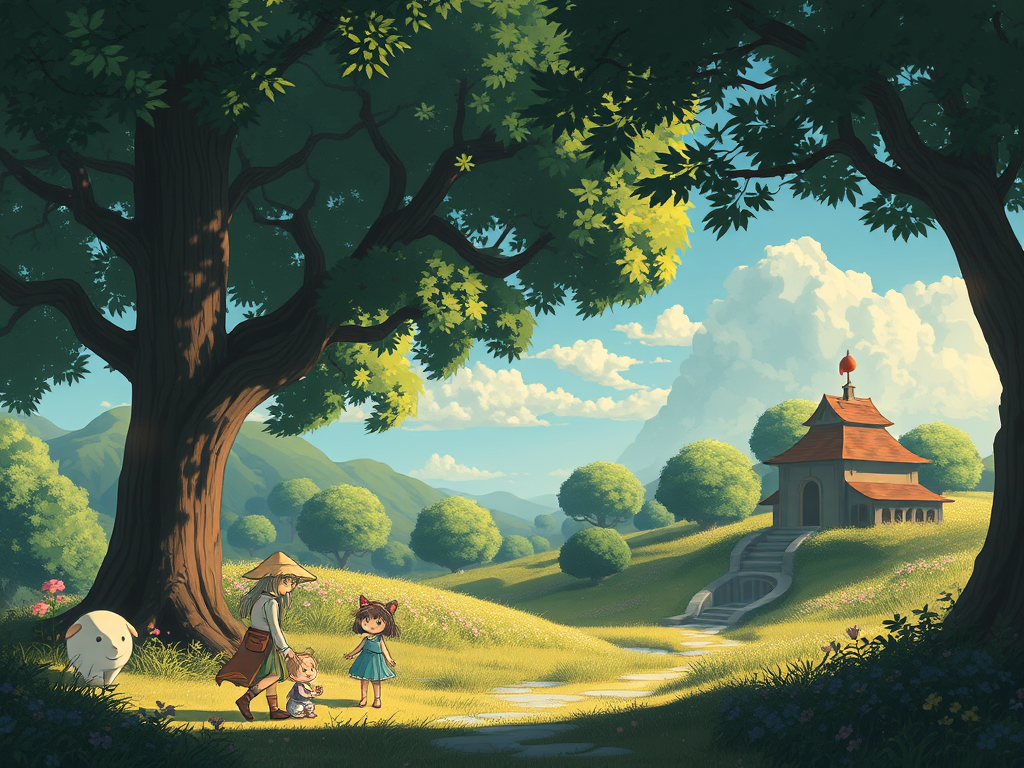
The so-called ‘Ghibli style’ comes from the Tokyo-based Japanese animation company ‘Studio Ghibli.’ It is one of the most recognizable styles in the animation industry. Studio Ghibli was founded by Hayao Miyazaki, Toshio Suzuki, and Isao Takahata. Miyazaki is one of the most famous and established animators in the world. His work has been awarded some of the most prestigious animation and film industry awards.
Miyazaki has been a brutal critic of AI’s use in animation and has always been vocal about his stance. In a resurfaced documentary about his work, Miyazaki, without hiding his disgust and outright anger towards an AI-generated animation clip, calls it an “insult to life itself”. He says, “I can’t watch this stuff and find [it] interesting. Whoever creates this stuff has no idea what pain is whatsoever. I am utterly disgusted. If you really want to make creepy stuff, you can go ahead and do it. I would never wish to incorporate this technology into my work at all.” Pain is the keyword here. What differentiates a ‘created’ piece of art from a ‘generated’ picture? Art cannot exist as a mechanical phenomenon; it cannot be industrialized and mass-produced like plastic chairs and slippers. Art always comes at a cost to the artist. The pain that Miyazaki refers to is the cost of the art that the artist pays; it originates from a subjectivity that is shared by those who appreciate it. It cannot be devoid of that subjectivity.
The new ChatGPT model is capable of generating images in every possible style that has ever existed in the art world, and it just might be capable of generating a mix of different styles and a seemingly ‘original’ style of its own. The aforementioned documentary showed how it took a Studio Ghibli artist more than a year and a quarter to paint a 4-second movie clip. With adequate infrastructure, AI can generate a similar clip within a minute. I saw a clip online in which two ‘Ghiblifed’ characters were engaged in a podcast-like situation. It had AI-generated audio, AI-generated script, and AI-generated animation. There was another AI-generated ‘reedition’ of a Hollywood film scene. There is a rapidly growing AI infestation on social media, and there seems to be no end to it.
All this chaos opens a dam of what I would call seemingly difficult ethical questions. How moral and ethical is it to hijack an artist’s style and use it to create something absolutely against his beliefs and ideology? Just the other day, the X handle of the Israeli Defense Forces posted Ghiblified pictures of their warships and guns. Isn’t it an absolute desecration of Miyazaki’s art and an outright insult to the artist? Using an artist’s style as a tool of warmongering propaganda without his consent. Is it appropriate to use the term ‘art’ for AI-generated images? Is it not an issue of copyright infringement if the generated ‘art’ is an outright copy or an artist’s work? Is it fair that the massive capital generated by AI companies on the backs of artists like Miyazaki has no share for the artists themselves? The questions are many; the answers are few.
The defenders of the ‘Ghiblified’ phenomenon paint a seemingly socialist yet brutally capitalist picture of the trend. A viral post on the internet defended the Ghiblification of pictures by narrating an anecdote about a working-class woman feeling joy after receiving her family’s Ghiblified pictures on her WhatsApp. There are many such anecdotes going viral on social media. The defenders of AI-generated ‘art’ are taking what they think is a socialist stance. Art for everybody. But I find it practically impossible to believe in it. Some are even trying to create logic by saying that since humans create AI, everything that AI creates is also made by humans. However, the problem is that AI cannot create; it is devoid of consciousness. It is beyond what Plato calls mimesis. Art itself, according to Plato, is a copy of a copy that is an object, which is a copy of the ideal. An artistic creation is an imitation of the material world, but it is an imitation that comes from within the artist. In his 1816 essay titled ‘On Gusto’, the 19th century English critic William Hazlitt defines the quality of intense and vivid expression in art and literature as ‘gusto’. Gusto is an inherent quality of every artist. We can be perfect in the same way, but our imperfections are always different. That is where ‘Gusto’ steps into the creation of art and literature. Art cannot exist without the said ‘Gusto’ of the artist. In the case of artificial intelligence, gusto itself cannot simply exist, which translates into the absence of the ‘art’ in art itself. A soulless imitation devoid of pain, expression, and originality.
It is extremely difficult to write in the defence of the Ghiblification phenomenon. Every road leads to the Rome of unoriginality and outright abomination. As someone who appreciates art and literature, I find it extremely difficult to defend what is nothing but a trend. I can only hope that this Ghiblification, Van Goghfication, or Renaissancefication takes the average internet user towards the original art. As a writer, I can only hope for the subversion of this all-encompassing hyperreal. I hope such a phenomenon generates curiosity among people to come back and appreciate the original productions of Studio Ghibli, the paintings of Van Gogh, or the grandeur of the Renaissance. We can only hope.
 Yasir Tehsin
Leave a comment